
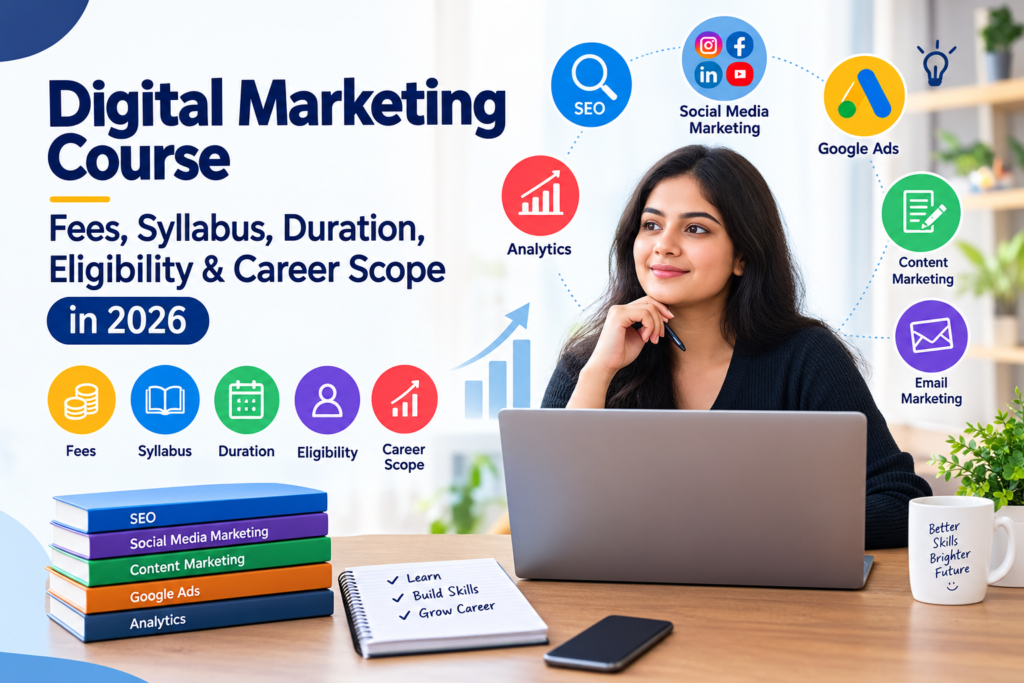
The growing use of websites, search engines, social media, online advertising, and e-commerce has made digital marketing an important skill for businesses and professionals. As companies increasingly use digital channels to reach customers, many students, graduates, freshers, working professionals, and entrepreneurs are exploring a digital marketing course to understand how online marketing works.
However, choosing a course can raise several questions. How much does a digital marketing course cost? What topics are included in the syllabus? How long does the course take? Is there any eligibility requirement? Can someone from a non-marketing background learn digital marketing? And what career opportunities are available after completing the course?
A good digital marketing course generally combines concepts with practical learning across areas such as SEO, social media marketing, paid advertising, content marketing, email marketing, analytics, and emerging AI tools.
This guide explains the digital marketing course fees, syllabus, duration, eligibility, learning formats, and career scope in 2026 to help beginners understand what they should look for before choosing a course.
What Is a Digital Marketing Course?
A digital marketing course is a structured learning program that teaches how businesses promote their products, services, websites, and brands through digital channels.
Unlike traditional marketing, which may rely on channels such as newspapers, television, radio, or outdoor advertising, digital marketing focuses on internet-based platforms. These include search engines, websites, social media platforms, email, online advertising networks, and other digital channels.
A digital marketing course can range from a short introductory program to a comprehensive professional training program. The exact curriculum depends on the institute, course duration, learning format, and level of training.
For beginners, a comprehensive course generally introduces the fundamentals first and then progresses toward practical applications.
What Do You Learn in a Digital Marketing Course?
A digital marketing course may cover several specialized areas, including:
- Search Engine Optimization (SEO)
- Search Engine Marketing (SEM)
- Pay-Per-Click (PPC) advertising
- Social media marketing
- Social media advertising
- Content marketing
- Email marketing
- Affiliate marketing
- Website analytics
- Conversion optimization
- Online reputation management
- Lead generation
- E-commerce marketing
- AI tools for marketing
The objective is not simply to learn individual platforms. Students should also understand how different digital channels work together as part of a marketing strategy.
For example, a business may use SEO to attract organic search traffic, social media to build awareness, Google Ads to generate immediate traffic, and analytics tools to measure campaign performance.
What Is Included in a Digital Marketing Course Syllabus?
The syllabus is one of the most important factors to examine before selecting a course. A comprehensive syllabus should cover fundamental digital marketing concepts as well as practical skills.
The exact modules vary between training providers, but the following subjects are commonly associated with digital marketing education.
Search Engine Optimization (SEO)
SEO is the process of improving a website’s visibility in organic search engine results.
A digital marketing course generally introduces students to different areas of SEO, including:
- Keyword research
- Search intent
- On-page SEO
- Technical SEO
- Off-page SEO
- Link building
- Local SEO
- Competitor research
- SEO audits
- Search performance analysis
Keyword research helps marketers understand what people search for online. On-page SEO focuses on elements within a website, such as page titles, headings, content, internal links, and other relevant factors.
Technical SEO deals with aspects that can affect how search engines crawl and understand a website. Off-page SEO includes activities that take place outside the website, such as earning relevant backlinks.
Local SEO is particularly useful for businesses serving specific geographic areas. For example, someone searching for a digital marketing course in Borivali or a digital marketing course in Andheri may have a location-specific search intent.
A practical SEO module should ideally include exercises rather than only theoretical explanations.
Search Engine Marketing and PPC
Search Engine Marketing, particularly paid search advertising, allows businesses to advertise their products or services on search engines.
A digital marketing course may introduce students to platforms such as Google Ads and explain concepts including:
- Keyword targeting
- Search campaigns
- Ad groups
- Ad copy
- Landing pages
- Bidding
- Budget management
- Conversion tracking
- Campaign optimization
- Performance reporting
PPC stands for Pay-Per-Click, referring to advertising models where advertisers can pay when users click on their advertisements.
Students should understand that running paid campaigns involves more than creating an advertisement. Campaign objectives, audience targeting, keyword selection, landing-page experience, budget allocation, and performance measurement all influence campaign management.
Social Media Marketing
Social media marketing involves using social platforms to communicate with audiences, build brand awareness, distribute content, generate leads, and support business objectives.
A digital marketing syllabus may include platforms such as:
- YouTube
- Other relevant social platforms
Students can learn about:
- Social media strategy
- Content planning
- Content calendars
- Audience research
- Organic social media
- Paid social advertising
- Engagement
- Community management
- Social media analytics
For example, a business targeting professionals may use LinkedIn differently from a consumer brand using Instagram. Understanding the audience and purpose of each platform is therefore an important part of social media marketing.
Content Marketing
Content is an important component of many digital marketing strategies.
Content marketing involves creating and distributing useful, relevant content to attract and engage a target audience.
A digital marketing course may cover:
- Blog writing
- Content strategy
- Keyword-focused content
- Website content
- Social media content
- Video content
- Infographics
- Content calendars
- Content distribution
For SEO-focused content, students should understand how to balance search optimization with readability and user intent.
For example, a blog about digital marketing course in Mumbai should not simply repeat the keyword multiple times. It should answer the questions that people searching for such a course are likely to have, such as fees, syllabus, duration, eligibility, learning format, and career opportunities.
Email Marketing
Email marketing allows businesses to communicate directly with subscribers, prospects, and customers.
A digital marketing course may introduce students to:
- Email campaign planning
- Audience segmentation
- Email copywriting
- Lead nurturing
- Automation
- Personalization
- Open and click tracking
- Campaign analysis
Email marketing can be used for different purposes, including newsletters, promotional campaigns, product updates, educational content, and customer communication.
Understanding the audience is important because effective email marketing is not simply about sending a large number of emails. Marketers need to consider relevance, timing, messaging, segmentation, and measurable objectives.
Web Analytics and Reporting
Digital marketing generates measurable data, making analytics an important part of the field.
A digital marketing course may introduce learners to tools such as Google Analytics and Google Search Console, depending on the curriculum and current platform features.
Students can learn to understand metrics such as:
- Website traffic
- Traffic sources
- User engagement
- Search performance
- Conversions
- Campaign performance
- Landing-page performance
Analytics helps marketers determine what is working and where improvements may be needed.
For example, a website may receive substantial traffic but generate relatively few enquiries. In such a situation, a marketer may examine landing pages, calls to action, user journeys, traffic sources, and conversion tracking to understand the issue.
AI in Digital Marketing
Artificial intelligence has become increasingly relevant to digital marketing workflows.
Modern digital marketing training may introduce learners to AI-assisted tools for tasks such as:
- Content research
- Brainstorming
- Content ideation
- Ad copy variations
- Audience research
- Data analysis
- Marketing automation
- Reporting
- Workflow optimization
AI can help marketers work more efficiently, but it does not remove the need for strategy, creativity, fact-checking, brand understanding, and human judgment.
For beginners, learning how to use AI responsibly can therefore complement traditional digital marketing skills.
How Much Does a Digital Marketing Course Cost?
One of the most common questions beginners ask is about digital marketing course fees.
There is no single fee applicable to every digital marketing course. Costs can differ significantly depending on the institute, curriculum, course duration, training format, faculty, practical components, certifications, tools, and additional services.
Some introductory courses may cover only a few modules, while comprehensive programs can include multiple areas of digital marketing and practical assignments.
Before comparing fees, students should understand exactly what is included in the quoted price.
What Factors Affect Digital Marketing Course Fees?
Several factors can influence course fees.
1. Course curriculum:
A course covering only basic concepts may have a different fee structure from a comprehensive program covering SEO, PPC, social media, analytics, content, and other modules.
2. Course duration:
Longer programs generally provide more time for instruction, assignments, and practical learning.
3. Practical training:
Projects, campaign simulations, website exercises, and hands-on assignments can affect the overall structure and cost of a program.
4. Faculty and training format:
Classroom-based, live online, recorded, and hybrid programs can have different pricing structures.
5. Certification:
Some programs include completion certificates or certifications as part of their course offering.
6. Career support:
Some training providers offer services such as interview preparation, resume assistance, portfolio guidance, or career counselling.
7. Learning resources and tools:
Access to learning materials, software, platforms, or other resources can also form part of a course offering.
Are Digital Marketing Courses Worth the Investment?
The value of a digital marketing course depends on what a learner expects to achieve from it and how effectively the acquired skills are applied.
A course can provide a structured learning path instead of requiring beginners to learn every topic independently. Practical assignments can also help learners develop experience with digital marketing tasks.
However, completing a course alone does not automatically create professional expertise. Digital marketing changes continuously, so professionals generally need to keep learning, practicing, analyzing campaigns, and adapting to changes in platforms and consumer behaviour.
When comparing courses, students should therefore look beyond the fee and examine the syllabus, practical exposure, faculty, learning format, projects, certification, and career support.
How Long Does a Digital Marketing Course Take?
Digital marketing course duration varies according to the depth and structure of the program.
A short introductory course may focus on fundamentals, while a comprehensive professional course can cover multiple modules over a longer period.
The duration can depend on:
- Number of modules
- Class frequency
- Learning format
- Practical assignments
- Course depth
- Weekend or weekday schedule
- Self-paced versus instructor-led learning
Some programs may be designed for students who can attend classes regularly, while others may accommodate working professionals through weekend or online sessions.
How Many Months Does It Take to Learn Digital Marketing?
There is no universal amount of time required to learn digital marketing.
A learner may understand the fundamentals relatively quickly, but developing practical proficiency requires continued practice.
For example, learning the basic concepts of SEO can be different from gaining the ability to conduct keyword research, optimize a website, analyze search performance, and develop an SEO strategy.
Similarly, understanding Google Ads is different from being able to plan, launch, monitor, and optimize advertising campaigns.
Therefore, course duration should be viewed as the structured learning period, rather than a guarantee of complete mastery.
Who Is Eligible for a Digital Marketing Course?
Eligibility requirements depend on the institute and the type of program.
Many beginner-oriented digital marketing courses are designed for people from different educational and professional backgrounds. Students, graduates, working professionals, entrepreneurs, freelancers, and career changers may all explore digital marketing as a skill area.
Important factors to consider include:
- Educational background
- Basic computer knowledge
- Communication skills
- Interest in online platforms
- Willingness to practice
- Ability to learn continuously
A specific marketing degree is not necessarily required for learning the fundamentals of digital marketing. However, learners should check the eligibility criteria of the particular course before enrolling.
Can Students Join a Digital Marketing Course After 12th?
Students who have completed Class 12 may explore beginner-level digital marketing programs, depending on the eligibility criteria established by the training provider.
Learning digital marketing after 12th can introduce students to areas such as SEO, social media, content, paid advertising, and analytics.
For students, the focus should be on building foundational knowledge and practical skills rather than expecting immediate professional mastery.
A student can gradually develop a portfolio through projects, content experiments, website exercises, or other practical assignments while continuing their education.
Can Graduates Learn Digital Marketing Without a Marketing Degree?
Yes, learners from different academic backgrounds can study digital marketing if the course accepts beginners.
Digital marketing includes technical, creative, analytical, and communication-related skills. A graduate from commerce, arts, science, management, technology, or another field may approach the subject from a different perspective.
What matters during the learning process is the willingness to understand digital platforms, practice the concepts, analyze results, and keep up with changes in the industry.
Is Digital Marketing a Good Career Option in 2026?
Digital marketing has become an important part of how businesses communicate with customers, generate leads, sell products, and build their online presence. Businesses across industries use websites, search engines, social media, email, online advertising, and other digital channels to reach audiences.
This creates opportunities for people who develop practical digital marketing skills.
A digital marketing career can involve different types of work, including SEO, social media, content marketing, paid advertising, analytics, email marketing, and broader digital marketing management.
Career options can be available in:
- Digital marketing agencies
- Startups
- E-commerce companies
- Technology companies
- Education businesses
- Healthcare organizations
- Hospitality businesses
- Real estate companies
- Retail businesses
- Media organizations
- Freelance businesses
The career path can also vary according to a person’s skills and experience. Someone may begin with an entry-level role and later specialize in an area such as SEO, performance marketing, social media, or analytics.
What Jobs Can You Get After a Digital Marketing Course?
Completing a digital marketing course can introduce learners to several potential job roles. The exact opportunities depend on an individual’s skills, experience, portfolio, qualifications, and the requirements of employers.
SEO Executive
An SEO Executive works on improving a website’s visibility in organic search results.
Typical responsibilities can include:
- Keyword research
- On-page optimization
- Content optimization
- Competitor analysis
- Technical SEO checks
- Internal linking
- Off-page SEO activities
- SEO reporting
An entry-level SEO professional generally needs an understanding of search intent, keyword research, on-page SEO, technical fundamentals, and analytics.
Social Media Executive
A Social Media Executive helps manage a brand’s presence across social media platforms.
Responsibilities may include:
- Creating content calendars
- Publishing social media posts
- Coordinating visual content
- Monitoring engagement
- Responding to audiences
- Tracking social media performance
- Supporting paid social campaigns
Creativity, communication, platform knowledge, and an understanding of target audiences can be useful skills for this role.
Performance Marketing Executive
Performance marketing focuses on measurable digital advertising activities.
A Performance Marketing Executive may work with platforms such as Google Ads or social advertising platforms.
Responsibilities can include:
- Campaign setup
- Audience targeting
- Keyword research
- Budget management
- Ad testing
- Conversion tracking
- Performance analysis
- Campaign optimization
Analytical thinking is particularly useful because performance marketers need to interpret campaign data and make adjustments based on results.
Content Marketing Executive
A Content Marketing Executive develops and manages content designed to inform, engage, or attract a target audience.
The role can involve:
- Blog content
- Website content
- Social media content
- Content calendars
- Content research
- SEO content
- Video concepts
- Content distribution
Strong writing and research skills can be valuable for this career path.
Email Marketing Specialist
Email marketing professionals plan and manage campaigns designed to communicate with subscribers and customers.
Their responsibilities may include:
- Creating email campaigns
- Writing email copy
- Managing subscriber lists
- Audience segmentation
- Email automation
- Campaign testing
- Performance reporting
Knowledge of customer journeys and marketing automation can be useful for this role.
Digital Marketing Executive
A Digital Marketing Executive may work across several digital channels instead of specializing in just one area.
Depending on the organization, responsibilities can include:
- SEO
- Social media
- Content
- Email marketing
- Paid advertising
- Website updates
- Lead generation
- Analytics
This role can provide exposure to different areas of digital marketing and may help professionals identify a specialization they want to pursue.
Digital Marketing Analyst
A Digital Marketing Analyst focuses on data and campaign performance.
The role can involve analyzing:
- Website traffic
- Campaign performance
- Conversion data
- Customer behaviour
- Search performance
- Advertising metrics
- Marketing reports
Analytical thinking and familiarity with analytics platforms can be important for this career path.
Freelancer or Independent Digital Marketer
Digital marketing skills can also be used to provide services independently.
Freelancers may offer services such as:
- SEO
- Social media management
- Content marketing
- Google Ads management
- Website optimization
- Email marketing
- Local SEO
Freelancing requires more than technical knowledge. Professionals also need skills related to client communication, project management, pricing, proposals, reporting, and business development.
What Is the Career Scope of Digital Marketing in India?
The scope of digital marketing in India extends across businesses of different sizes and industries.
Organizations can use digital channels for brand awareness, customer acquisition, lead generation, e-commerce, customer communication, and retention.
This creates different career paths for people interested in digital marketing.
Someone searching for a digital marketing course in India may therefore find opportunities across areas such as:
- SEO
- Social media marketing
- Performance marketing
- Content marketing
- Email marketing
- Analytics
- E-commerce marketing
- Influencer marketing
- Affiliate marketing
- Marketing automation
The industry is also continuously changing. Search engine algorithms, advertising platforms, social media features, analytics tools, and AI technologies can change the way marketers work.
As a result, digital marketing professionals need to treat learning as an ongoing process rather than something that ends after completing a single course.
Digital Marketing Course in Mumbai: What Should Students Look For?
Mumbai has a large ecosystem of businesses, startups, agencies, educational institutions, e-commerce companies, and other organizations that use digital marketing.
As a result, students and professionals searching for a digital marketing course in Mumbai can find different types of training programs.
Before selecting one, learners should compare the actual learning experience rather than choosing a course based only on its name or advertised fee.
Important factors include:
Course Curriculum
Check whether the curriculum covers the major areas required for the learner’s goals.
A comprehensive program may include SEO, social media marketing, Google Ads, content marketing, analytics, email marketing, and other relevant topics.
Practical Projects
Practical assignments can help learners understand how digital marketing concepts work in real situations.
Students can look for courses that include activities such as:
- Keyword research
- SEO audits
- Content creation
- Campaign planning
- Advertising exercises
- Analytics reporting
- Social media projects
Faculty Experience
Learners should understand who will conduct the training and whether instructors have relevant practical knowledge.
Tools and Platforms
Digital marketing involves a wide range of tools. Students should check which platforms are included in the curriculum.
Certification
Students should understand what type of certificate they receive, who issues it, and what the certification represents.
Career Support
Some courses provide services such as resume guidance, interview preparation, portfolio development, or career counselling. Students should understand exactly what is included instead of assuming that career support means guaranteed employment.
Digital Marketing Course in Andheri: What Are the Key Things to Consider?
Andheri is one of Mumbai’s major commercial and residential areas, and learners may search specifically for a digital marketing course in Andheri because of its accessibility and the availability of training options.
When comparing courses in Andheri, learners can evaluate:
- Course curriculum
- Training schedule
- Course duration
- Practical assignments
- Faculty
- Learning format
- Certification
- Career support
- Total fees
- Student reviews
- Accessibility
Location can be convenient, but it should not be the only factor when choosing a course.
A course that fits a learner’s schedule, learning objectives, and preferred teaching format may be more relevant than simply selecting a program based on proximity.
Digital Marketing Course in Borivali: Is It Suitable for Beginners?
Students and professionals living in Mumbai’s western suburbs may also search for a digital marketing course in Borivali.
For beginners, the most important consideration is whether the course provides a structured introduction to digital marketing.
A beginner-friendly program should explain fundamental concepts before moving into advanced topics.
Learners can check whether the course includes:
- Basic digital marketing concepts
- SEO fundamentals
- Social media marketing
- Paid advertising
- Content marketing
- Analytics
- Practical projects
- Assignments
- Certification
- Career guidance
Beginners should also consider the time required outside classroom sessions. Digital marketing skills improve through practice, so learners may need to spend additional time working on assignments and projects.
Online vs Offline Digital Marketing Course: What Is the Difference?
Digital marketing courses are available in online, offline, and hybrid formats.
Each format has different characteristics, and the appropriate choice can depend on the learner’s schedule, location, learning preferences, and access to classroom interaction.
| Factor | Online Course | Offline Course |
|---|---|---|
| Flexibility | Usually higher | Depends on class schedule |
| Classroom interaction | Virtual interaction | Direct interaction |
| Location dependency | Lower | Higher |
| Networking | Primarily online | Face-to-face opportunities |
| Learning pace | Can be flexible in some programs | Usually follows class schedule |
| Practical support | Online assignments and sessions | Classroom-based activities may be available |
| Travel | No regular commute | Requires travel |
| Learning environment | Home/remote environment | Physical classroom |
There is no single format that works for every learner.
Someone with a busy work schedule may value online flexibility, while a learner who prefers direct classroom interaction may prefer offline training.
How to Choose the Right Digital Marketing Course?
Choosing a course requires more than comparing fees.
The following checklist can help students evaluate different programs.
1. Check the Syllabus
Look for a curriculum covering the subjects relevant to the learner’s goals.
2. Compare Course Duration
Understand how many classes or learning hours are included and whether the schedule fits personal commitments.
3. Understand the Fee Structure
Check the total course fee and identify whether additional costs apply.
4. Look for Practical Projects
A practical component can help learners apply concepts instead of only studying theory.
5. Research the Faculty
Understand the instructors’ background and areas of expertise.
6. Check the Tools Covered
Look at the platforms and tools included in the course.
7. Understand Certification
Check the certification details and issuing organization.
8. Review Career Support
Understand whether the program offers resume assistance, interview preparation, portfolio development, or other career services.
9. Check Student Reviews Carefully
Reviews can provide useful perspectives, but students should consider multiple sources and look for detailed, verifiable experiences.
10. Compare Online and Offline Formats
Consider flexibility, classroom interaction, travel, schedule, and learning preferences.
11. Check Whether the Curriculum Is Updated
Digital marketing changes frequently, so an updated curriculum can be important.
12. Read the Terms and Conditions
Before enrolling, learners should understand payment terms, cancellation policies, course access, certification conditions, and other relevant policies.
What Skills Are Needed to Succeed in Digital Marketing?
A digital marketer needs more than knowledge of individual tools.
Some useful skills include:
Communication
Digital marketers regularly communicate through written content, advertisements, emails, presentations, and client interactions.
Creativity
Creative thinking can help marketers develop content, campaigns, advertising concepts, and new ways of communicating with audiences.
Analytical Thinking
Marketing data can help professionals understand campaign performance and identify areas for improvement.
SEO Knowledge
Understanding search engines, keywords, content, and website optimization is useful for organic marketing.
Advertising Knowledge
Paid advertising requires an understanding of audiences, budgets, campaign objectives, creative assets, and performance data.
Content Creation
Content skills are useful across websites, blogs, social media, email, and other digital channels.
Problem-Solving
Campaigns do not always perform as expected. Marketers need to identify potential problems and test solutions.
Adaptability
Digital platforms and marketing practices change frequently. Professionals need to keep learning.
AI Literacy
Understanding how to use AI tools responsibly can help marketers with research, content workflows, analysis, and automation while maintaining human oversight.
Frequently Asked Questions About Digital Marketing Courses
What Is a Digital Marketing Course?
A digital marketing course is a structured program that teaches learners how to promote businesses, products, services, and brands through online channels. Common subjects include SEO, social media marketing, paid advertising, content marketing, email marketing, and analytics.
How Much Does a Digital Marketing Course Cost?
Digital marketing course fees vary depending on the institute, curriculum, duration, learning format, practical training, certification, faculty, and career support. Students should compare what is included in the fee rather than comparing price alone.
How Long Is a Digital Marketing Course?
Course duration varies according to the depth and structure of the program. Short introductory programs can be completed relatively quickly, while comprehensive courses may require several months of structured learning and practice.
What Is the Eligibility for a Digital Marketing Course?
Eligibility depends on the course provider. Many beginner-level programs are open to students, graduates, working professionals, entrepreneurs, and career changers. Specific requirements should be checked with the individual institute.
Can I Learn Digital Marketing After 12th?
Yes, students who have completed Class 12 can explore beginner-level digital marketing courses, depending on the eligibility requirements of the training provider.
Is Digital Marketing Difficult for Beginners?
The fundamentals of digital marketing can be learned by beginners. However, developing practical proficiency requires consistent learning and practice because digital marketing includes multiple areas such as SEO, advertising, content, social media, and analytics.
Is Certification Necessary for a Digital Marketing Job?
Certification can demonstrate that a person has completed a particular training program, but employers may also consider practical skills, experience, portfolio projects, communication, analytical ability, and knowledge of relevant tools.
What Jobs Are Available After a Digital Marketing Course?
Depending on their skills and experience, learners may explore roles such as SEO Executive, Social Media Executive, Performance Marketing Executive, Content Marketing Executive, Email Marketing Specialist, Digital Marketing Executive, or Digital Marketing Analyst.
Can Digital Marketing Be Learned Online?
Yes. Digital marketing can be learned through online courses, live virtual classes, recorded programs, tutorials, practical projects, and self-directed learning. Online and offline formats have different advantages depending on the learner’s preferences and circumstances.
What Is the Difference Between SEO and Digital Marketing?
SEO is one component of digital marketing. SEO focuses primarily on improving organic search visibility, while digital marketing covers a broader range of activities, including SEO, paid advertising, social media, content marketing, email marketing, analytics, and other online channels.
Conclusion
A digital marketing course can provide beginners with a structured way to understand the major components of online marketing. From SEO and social media marketing to paid advertising, content, email marketing, analytics, and AI tools, the field covers a wide range of skills.
Before selecting a course, learners should consider several factors, including fees, syllabus, duration, eligibility, practical training, certification, learning format, faculty, and career support.
The right choice can differ from one learner to another. A student may prioritize practical projects and foundational knowledge, while a working professional may place greater importance on flexible schedules. Someone looking for a digital marketing course in Mumbai, digital marketing course in Andheri, or digital marketing course in Borivali can compare programs based on curriculum, accessibility, training format, and learning objectives.
For learners exploring opportunities beyond Mumbai, a digital marketing course in India can also provide a foundation for careers across SEO, social media, performance marketing, content, analytics, freelancing, and other digital marketing areas.
Most importantly, digital marketing is a continuously evolving field. Completing a course can provide a foundation, but ongoing practice, experimentation, analysis, and learning remain important for developing long-term skills.
SEO Elements
SEO Title
Digital Marketing Course: Fees, Syllabus & Career 2026
Meta Description
Learn about digital marketing course fees, syllabus, duration, eligibility, career scope, jobs and how to choose the right course in 2026.
URL Slug
/digital-marketing-course-fees-syllabus-career/
Primary Keyword
digital marketing course
Secondary Keywords
- digital marketing course in Mumbai
- digital marketing course in Andheri
- digital marketing course in Borivali
- digital marketing course in India
- digital marketing course fees
- digital marketing course syllabus
- digital marketing course duration
- digital marketing course eligibility
- digital marketing certification
- digital marketing training
- digital marketing jobs
- digital marketing career
- digital marketing skills
Featured Image Alt Text
Digital marketing course fees, syllabus, duration, eligibility and career scope in 2026
Suggested Image Title
Digital Marketing Course: Fees, Syllabus, Duration & Career Scope 2026
Suggested FAQ Schema Questions
- What is a digital marketing course?
- How much does a digital marketing course cost?
- How long is a digital marketing course?
- What is the eligibility for a digital marketing course?
- Can I learn digital marketing after 12th?
- Is digital marketing difficult for beginners?
- Is certification necessary for a digital marketing job?
- What jobs are available after a digital marketing course?
- Can digital marketing be learned online?
- What is the difference between SEO and digital marketing?
Internal Linking Suggestions
Use relevant internal pages with anchor text such as:
- Digital Marketing Course in Mumbai
- Digital Marketing Course in Andheri
- Digital Marketing Course in Borivali
- SEO Training
- Social Media Marketing Course
- Google Ads Course
- Digital Marketing Certification
- Digital Marketing Institute